Nancy Supriya Sachamitr is a coordinator with the Kellogg-WHU Executive MBA program. She has a masters degree in Bioscience Technology, and prior to her current job, she worked at the Max Planck Institute for Molecular Biomedicine as a research associate. Here, she shares the story of her transition from a researcher to an education management professional.
I have known Nancy for a while now, and her career transformation has been quite an inspiration for many of us who knew her through the CiM-IMPRS graduate program. An effervescent personality, Nancy is undeniably a people person. Therefore, when she decided to leave research, she quickly found a niche in a sector that involves active interaction with people. Education management (as alien as it may sound) is indeed a viable career alternative for people with a science background, encompassing mostly work within the University environment, this particular career option is all about utilizing transferable skills – as I learnt through this interview with Nancy.
So, what are the responsibilities of a coordinator?
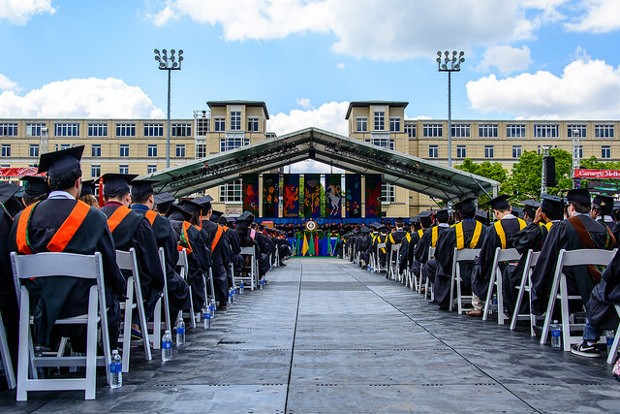
As a program coordinator, I am responsible for the smooth operation of the Kellogg-WHU Executive MBA program through interface between its international executive students and the program along with its 6 prestigious partner in Chicago, Miami, Hong Kong, Toronto, Beijing and Tel Aviv. My main tasks are to provide an exceptional student experience through the organization of events, which includes live-in weeks and weekends on- and off-campus, graduation ceremonies, leadership development programs and senior speaker series.
And what made you leave the confines of a laboratory to carry out such a completely contrasting vocation?
Of course, this was not an easy decision but I was simply unhappy with my daily life as a scientist. Overall I liked the idea of being a scientist, but after 6 months of research this wasn’t reason enough to motivate me to get out of bed in the morning. I still enjoy reading and discussing interesting facts on science. I just prefer not to carry out the research myself. Additionally, everyone who knows me knows that I am a people person. In my current job as the interface of the program, I constantly have to interact with members of my team, other WHU staff, global network staff, external service providers and students for the smooth operation of the program, which, in my opinion, is what gives flavour to the job.
Leaving scientific work altogether is, without doubt, a difficult decision for any researcher, but if such a choice were to be made, how does one start from scratch to define a new career path for oneself? Everybody has talents and passion for things extraneous to actual research, but not all have the confidence to turn their skills into a career. Obviously, your self-confidence played a great role in landing your job as a coordinator, but what made you realize that this was the right profession for you and how did you prepare yourself to face the job market?
I was always proactive as a student, since my school days in India and through university. I volunteered as an organiser of multiple events and was always happy to represent the student body. I always knew that I loved organisation and operations of events. During my research years in Muenster, I also was one of the 3 main moderators of the annual student-organised international conference, where we had 22 world renowned, including a Nobel laureate, and over 200 participants. The success of this event and the rush it gave me was like a tipping point, helping me to realise that academic research was not the path that I could follow. Thereafter, thanks to the kindness of my mentor, I had the opportunity to hone my skills through an internship as a program assistant in the CEDAD-IMPRS graduate program.
Looking back, it took 3 steps for me to find the right path: Realisation, Networking and Action. After I had fully made up my mind to leave the research path, it helped me immensely to talk to people. I got in touch with people who moved away from the hard sciences into communications-related positions. These people gave me confidence to go the unconventional path.
Your internship and other experiences definitely boosted your C.V., but at the application stage you were still a scientist. With the decision made, how did you go about carrying out the job hunting process and how did you convince the employers that you were the right person to coordinate an educational program as divergent as an MBA?
The application process was the toughest and most frustrating part of the change. These were the hardest months, as I constantly felt rejected. Through my university in York, I got in touch with a career consultant who specialized in careers for scientists. She looked at my CV and helped make it a skills-based CV rather than a chronological CV. I had subscription to many job websites including jobvector, academics.de, nature jobs, etc. I was targeting science communications-related jobs and found the job at WHU on academics.de. It had nothing to do with science but I thought that it matched with the skills that I would like to utilize. I tailored my cover letter and CV so that it concentrated on my communicating and organisations skills. I was contacted just 2 days after. I had 3 interviews (department head + team, HR and Dean) and had to show that I had a minimum understanding of German. As I would be working with many partner schools around the world, my international background and language skills was a definite point in favor. They were, of course, curious about my will to leave science, but I convinced them that that was a path l didn't want to go back on.
It delights me greatly that you have found the right profession through hard work and perseverance. There might be people who have already decided or currently pondering about leaving research or science. I myself know some PhD students who would like to leave academia but are rather fearful of leaving their ‘comfort zones’. What would you like to tell them?
I admire those who have the patience and perseverance to stay in science. We need people like that! But for those who want to leave, I think life is too short to spend feeling secure and just sticking with a job where you can derive no satisfaction from. Take a chance on what you love! If you believe in it, it might not be an easy road, but you will make it there in the end and you will surely be proud of yourself!
This was indeed a very interesting career-related interview for me, and I would like to thank Nancy for her candid and heartfelt responses.
Cover image: Source: Flickr(Drpavloff)
Stats
- Recommendations n/a n/a positive of 0 vote(s)
- Views 2614
- Comments 0