
About
The Schultz group develops tools for imaging and for manipulating cellular enzyme activities, with a particular emphasis on the hereditary disease cystic fibrosis.
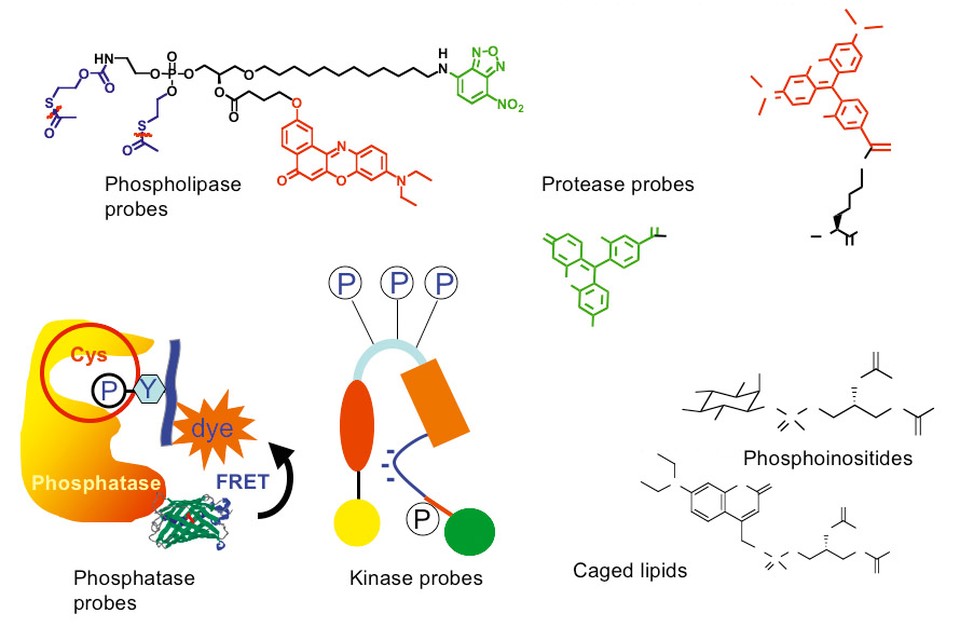 Image 1
 Previous and current research
Past projects: Before joining EMBL in 2001, our research focused on finding novel ways to stimulate chloride and water secretion of epithelial cells in understanding the genetic disease cystic fibrosis (CF). Our compounds helped to investigate some of the underlying intracellular signalling pathways and provided drug candidates to eventually treat CF patients. Of particular significance was the development of chemical methods to convert highly polar signalling molecules like cyclic nucleotides, inositol phosphates and phosphoinositides to membrane-permeant, bioactivatable derivatives (‘prodrugs’) (Schultz, 2003; Laketa et al., 2009).
Current projects: Our interest in CF has shifted to the development of lung emphysema (the ultimate cause of death in the patient). In a truly translational collaboration with the Mall group (Molecular Medicine Partnership Unit), we developed FRET reporters to sense enzyme activities detrimental to lung tissue such as macrophage and neutrophil elastases. In ex vivo experiments, we are now able to monitor these enzyme activities on cells from both mouse models and patients (Cobos et al., 2009; Gehrig et al., submitted). At the cell biology level, our interest shifted to basic signalling networks regulated by G-protein-coupled as well as growth factor receptors. We developed a wide range of fluorescent reporter molecules either genetically encoded (Piljic & Schultz, 2011) or as small molecule fluorescent probes (see figure). We hope to provide a more complete picture of the signalling network and to help find compounds beneficial in unravelling basic principles in signal transduction and, ultimately, in ion and enzyme secretion relevant to CF patients. In addition, we prepared a large number of tools to manipulate signalling networks and are able to locally activate the important second messenger PIP3 and other signalling lipids with a light flash in subcellular resolution in living cells (Mentel et al., 2011). Alternatively, we switch on enzymes such as single G-proteins by translocating them to their site of action with the help of a chemical dimeriser (Putyrski et al., 2011).
Hot projects: Currently, we are very excited about performing bioorthogonal chemistry inside living cells. In collaboration with the Lemke group, we developed a new set of amino acids that can be site-specifically incorporated into a protein of interest by amber stop codon suppression and then labelled in vivo with a fluorogenic compound. This provides access to labelling with high quality dyes and minimal disruption of the protein structure (Plass et al., 2011; Plass et al., submitted). In collaboration with the Häring group, we developed a new method to cross-link proteins in a protein-protein interaction-dependent fashion in living cells by using FlAsH technology (Rutkowska et al., 2011).
Future projects and goals
In 2012, we will focus predominantly on lipid signalling and lipid-controlled cell biology and examine the effect of phospholipids on endocytosis and lipid trafficking in collaboration with the Pepperkok group. Most projects rely on organic chemistry and the group has a significant number of preparative chemists at the graduate student and postdoc level. The symbiosis of chemistry, biochemistry, and cell biology opens new doors and grants novel insights into how cells function.
Head: Dr. Carsten Schultz
Structure relations
Cystic Fibrosis Research Group, European Molecular Biology Laboratory is the same as this level.
Contact details
Please sign in to see contact details.
Stats
- Recommendations n/a n/a positive of 0 vote(s)
- Views
- Comments 0